Showing posts with label Christoph Vogel. Show all posts

Tuesday, 17 September 2013

Eastern Congo's Recent Troubles - Who Pulls the Strings, What Is At Stake, and Why Do Things Happen?

Christoph Vogel, AllAfrica

Considered an overview, this piece combines a wide range of events, observations, and consequent thoughts on the current situation in the eastern DRC. Focusing on M23 rebels, DRC government, and the UN mission it will also take into account main other dynamics and actors.

An accumulation of events
In the last few weeks, the often low-intensity conflict in eastern Democratic Republic Congo (DRC) became not so low in intensity with newsworthy events unfolding on an almost daily basis. North of Goma fresh clashes broke out between the Congolese armed forces (FARDC) and the notorious M23 rebel movement.

During the ensuing bombing, various neighbourhoods in Goma were hit, as well as Rwandan territory in Rubavu district, bordering the DRC. The UN peacekeeping mission in the Congo, MONUSCO, for the first time engaged in offensive operations through its newly created Force Intervention Brigade (FIB) and faced fierce protests from residents of Goma resulting in tumultuous scenes in the bustling border town. One peacekeeper was killed andthe shelling of Rubavu provoked a military build-up by the Rwandan army on the border. After several days of joint FARDC-MONUSCO offensives (with losses suffered), M23 retreated from Kibati and announced a unilateral ceasefire, asking for the Kampala peace talks to resume.

Relations between the DRC government and its Rwandan counterparts have hit rock bottom and both regional and international mediation efforts have ground to a temporary halt. With opinions varying between anticipation of a window of opportunity and imminent regional war it is time to ask: Who pulls the strings, what is at stake, and why do things happen?

Tuesday, 3 September 2013

Congo: Why UN peacekeepers have a credibility problem

Christoph Vogel, The Guardian

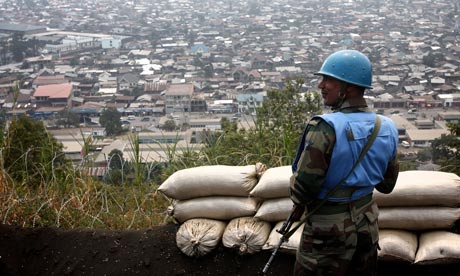
MDG : Goma, DRC :  An Indian UN peacekeeper stands on Mount GomaAfter 14 years, with a budget of $1.5bn a year, and employing 20,000 uniformed staff, the UN peacekeeping force in the Democratic Republic of the Congo is the largest mission in the organisation's history. Yet the force, currently known as Monusco, is struggling for credibility. On Twitter, critics have given it the hashtag #MONUSELESS.

Peacekeepers have been blamed for standing by when rebels from the allegedly Rwanda-backed March 23 movement (M23) conquered the city of Goma for 10 days last November. It has also been accused of blurring the lines between military and humanitarian activity, and for having an appalling record in protecting the civilian population – one of its two major aims. The second is to help restoring state authority, which requires engaging with politicians and public servants with sometimes dubious motives and propping up an army notorious for human rights abuses.

Monusco and its predecessor, Monuc, never had an easy task. Started in 1999 as an observer mission, a relatively small team found itself watching the gloomy reality of a conflict known as Africa's "world war", pitting nine countries and even more rebel groups against each other. The UN security council enlarged the mission, expanded its mandate and tasked it with ensuring the success of Congo's first democratic elections in 2006. But Monuc often remained toothless, depending on additional backup: during elections an EU force was called on to secure Kinshasa. Monuc was not able to prevent the siege of Bukavu by rebel commanders in 2004 or to counter threats posed by the Rwandan FDLR militia or Laurent Nkunda's National Congress for the Defence of the Congolese People (CNDP) rebellion.

Ironically labelled a post-conflict country since the 2006 election, the DRC continued to suffer from ill-conceived international intervention, insecurity, and ongoing rebel attacks in the east. In 2010 this culminated in Monuc's transition to Monusco, following growing international criticism and threats of expulsion from the president, Joseph Kabila. During the country's second elections in 2011, Monusco witnessed a rise in armed group activity in eastern Congo and the subsequent creation of M23.

Saturday, 20 July 2013

DRC: Who are the Raïa Mutomboki?

Christoph Vogel, Think Africa Press

Bukavu, Democractic Republic of the Congo:
After a period of relative calm, fighting has erupted once more around the town of Bunyakiri in South Kivu, in the eastern Democratic Republic of Congo (DRC). Reports from the area suggest that in early June, members of two armed groups burned down villages of their opposing constituencies following a dispute. In the subsequent days, further skirmishes evolved, ultimately including a third rebel group based in the area. The violence involved a militia called the Raïa Mutomboki clashing with Nyatura, a Hutu armed group allied to the Congolese army, and with the Mayi-Mayi Kifuafua, a former splinter group of the Raïa Mutomboki.
The Raïa Mutomboki are a frequently discussed militia group in reports of conflict in the DRC. But who are they, what are their origins and what are their motivations?

Who are the Raïa Mutomboki?
The Raïa Mutomboki – meaning ‘citizens in anger’ in Kiswahili – are a mix of localised self-defence militia and decentralised rebel army. Made up of many loosely-affiliated units, the Raïa Mutomboki emerged in 2005 among remote rural populations in the disputed eastern DRC, a region in which the Congolese government and army have been largely absent for long periods of time. Raïa Mutomboki’s membership is fluid and is mostly made up of civilians who take up arms at specific points in time. This makes estimating the size of the militia difficult, but there may be as many as a few thousand members.

The Raïa Mutomboki purportedly emerged as a means of self-defence following the massacre of 12 civilians in the village of Kyoka by the FDLR, a Rwandan Hutu rebel group predominantly made up of

Sunday, 2 June 2013

Taking the Fight to the DRC Rebels: The Potential Pitfalls of a UN Intervention Brigade

by Christoph Vogel
ThinkAfricaPress

The creation of a special UN unit in the DRC to conduct "targeted offensive operations" against rebel groups could prove helpful, but there are also dangers

Christoph VogelBukavu, DRC:

At the end of March, the United Nations Security Council unanimously approved Resolution 2098. This not only extended the mandate of MONUSCO, the UN peacekeeping force in the Democratic Republic of Congo (DRC), until 2014, but also catered for the creation of an Intervention Brigade, a new special unit tasked with conducting "targeted offensive operations" against rebel groups.

Led by a Tanzanian general, the Intervention Brigade will be composed of 3,069 troops, organised into three infantry battalions, one artillery, and one Special Force and reconnaissance company. Tanzania, Malawi, and South Africa will all contribute troops, and the brigade will be mandated to “prevent the expansion of all armed groups, neutralize these groups, and to disarm them”.

One of the incentives behind the creation of the brigade was impotence of MONUSCO last year in the face of the eastern Congolese rebels M23 as they seized towns and cities right under UN peacekeepers’ noses.

Wednesday, 15 May 2013

Congo's Most Powerful Rebel Speaks

Timo Mueller & Christoph Vogel
Real Clear World

Colonel Makenga, center, commander of the M23 rebel movement.It was a rainy Sunday afternoon in early April when we called "Brigadier General" Sultani Makenga, the military leader of M23, currently one of the strongest armed groups in eastern Congo. Working as field researchers in the Kivus, we wanted to engage with him face-to-face to capture his take on the DR Congo's state of affairs and learn first-hand about the latest developments inside the rebellion. M23 was consumed by heavy infighting in recent weeks, after latent fractions and fissures between Makenga and his rival Bosco Ntaganda erupted into open and violent conflict. In the ensuing whirlwind of events, Makenga regained the upper hand in late March, and Ntaganda surrendered to the International Criminal Court, leaving many of his men with no choice but to re-defect.

The initial telephone conversation was an unanticipated success. With little hesitation, Makenga agreed to meet us. The ensuing organizational logistics were simple and matter of fact, conducted via text message informing us of his whereabouts north of the provincial capital of Goma. As an individual sanctioned by the United Nations and the United States government, he remained relatively unconcerned and non-clandestine about his location.